Shipping Lead Time
Ships via UPS ground within 2-3 business days. Usually delivered within 1 to 1-1/2 weeks

Ships via UPS ground within 2-3 business days. Usually delivered within 1 to 1-1/2 weeks
Get the right advice from barn door specialists
We have 3 trees planted for each hardware kit sold
We’re available to help you from 9am - 5pm, weekdays on phone, chat & email
– David S.
With its low-profile hanger design, this unassuming yet sturdy hardware kit requires the least amount of overhead space when installing, so it is perfect for tall doorways or low ceilings. This is a barn door hardware kit and does not include doors. We do sell barn doors and they can be found on the Barn Door Collection Page.
Includes floor mounted dual-clip floor guides to keep your door from swaying
Polymer nylon wheels so that your door glides along the track quietly and smoothly
Tracks are drilled at 16" on center to align with stud spacing for easy installation on tracks up to 8'
Customize the open/close position of your doors with adjustable door stops
Includes everything you require to mount your doors (door & handle not included)
Easy-to-follow written & video installation instructions to make installation a breeze
Available in the two most popular finish options: Flat Black or Brushed Nickel
We offer a 5 year, "no questions asked" warranty on all hardware parts
Compatible with doors 1-3/8" to 1- 3/4" thick. If your doors are thicker or thinner you will require:
Built for a maximum weight capacity of 250lbs per door
This kit requires 4-5/8" from top of door to ceiling for installation
The distance from wall to outside edge of door is 2-1/4"
Heavy-duty 1/4" powder-coated steel tracks and hangers are built tough to last a lifetime
Learn the difference between the Low Profile and the Classic Strap hanger designs
A single door is used for narrow doorways that have enough space on one side of the doorway to slide the door over when opening it. Doorways without enough space will require a bypass hardware kit.
Recommended track length: twice the width of your door
A double door (bi-part) configuration is used when there is enough space on both sides of the doorway. The doors meet in the middle and are pushed to either side when opening.
Recommended track length: twice as long as the combined width of both of your doors
Find out what components are included with your barn door hardware kit (Door not included)
Our detailed installation guides and spec sheets make it easy to plan your installation
Shipping fee is $29. Ships within 3 business days via UPS from Atlanta, Georgia. Hardware kits are typically delivered within 1 to 1-1/2 weeks.
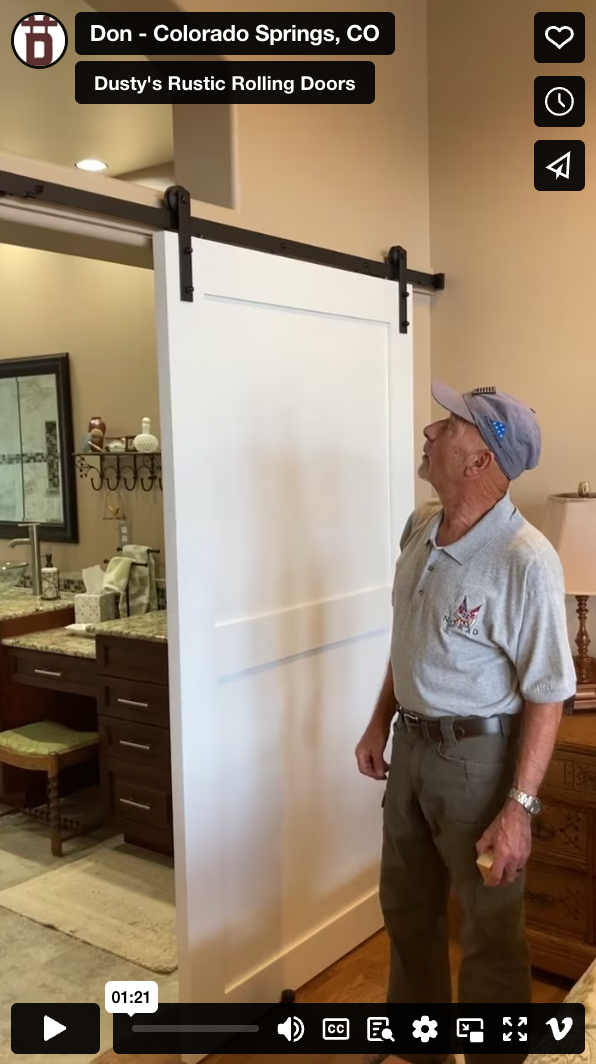
Don shows us the charming barn door installation he did using the Low Profile Single Barn Door Hardware Kit to separate his master bedroom and the ensuite bathroom.

Derk shows us the beautiful barn door he built to close off his closet using the Low Profile Single Barn Door Hardware Kit.
Margaret used the Low Profile Double Barn Door Hardware Kit to turn the double parlor in her old Victorian house into two rooms, which can separate an extra guest room from her living room.
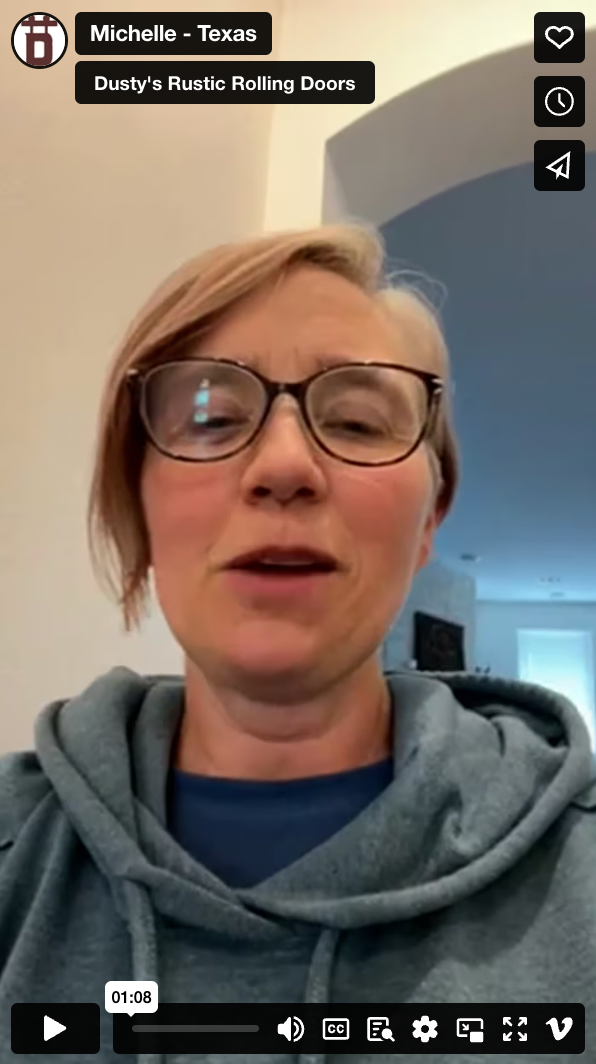
Michelle used the Low Profile Barn Door Hardware Kit to hang the beautiful barn doors her husband built to close off their laundry room.
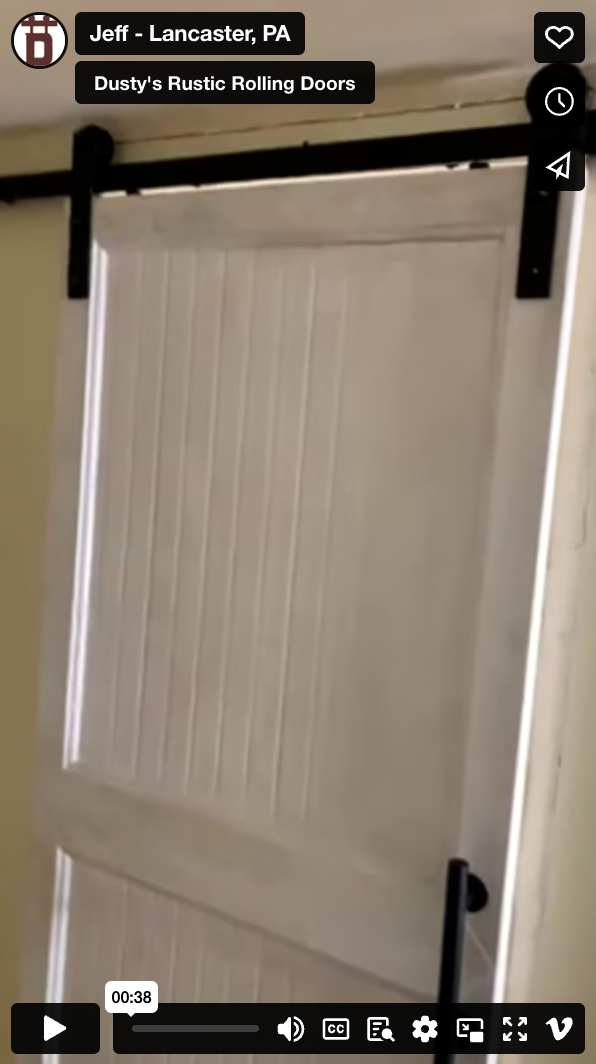
Jeff used the Low Profile Barn Door Hardware Kit to install a barn door in his hallway despite having low ceilings. He shows us how well it turned out.
Carol used the Low Profile Barn Door Hardware Kits to hang french doors in her Cape Cod home.
Very happy to support this business
Thank you, Kraig! We truly appreciate your support and are grateful that you chose to do business with us. It means a lot!
Great product. Very well built
Third kit ive bought and they are as solid as ever
This barn door track was exactly what we needed for our tight space. We had two local handymen turn down our installation job with the first barn door track we bought from another company because there wasn't enough room.
I reached out to Dusty's and provided all the measurements of our space and door to get confirmation that this would work for our space. They said it would work, so we ordered it and successfully got our door installed! It's great quality hardware, looks good, and works in very tight spaces. Highly recommend!
Thank you so much for sharing this!
We’re really glad we could help you find the right solution for your space and that the installation was a success. It means a lot that you trusted us with your measurements.
We truly appreciate the recommendation!
Great product love it
Glad to hear it Kevin, thank you for leaving us witha 5 star rating!
If you love the look of a rolling barn door but your header space, wall setback, or design sensibility won't allow for bulky strap hinges and thick track, a flush mount sliding door kit solves the problem. This guide walks through what low-clearance, slim-profile hardware actually is, how it installs, and what to check before you buy — using Dusty's Low Profile Single/Double Barn Door Hardware Kit as the reference point throughout.
Before comparing specs, it helps to know that "flush mount," "low profile," "slim," and "minimalist" are largely describing the same design idea from different angles: hardware that sits closer to the door and the wall than traditional strap-style barn door systems, so it takes up less visual and physical space.
The concept of “flush mount” does not exist when it comes to flat track barn door hardware. The straps either sit on the front of the door or are placed on top of the door in the case of top mount hangers. If having the straps flush with the front of the door is important to you, then you would need to route out the shape of the hanger on the front of the door so that the hanger sits flush with the surface of the door. However, the acorn nuts on the front of the hanger would still extend out past the door.
"Slim" hardware refers to the distance from the wall to the outside edge of the door. Our house brand of single track hardware kits comes with extendable spacers that allow the track to be pushed out or brought closer to the wall. This is useful when installing a thicker door, as the spacers can be extended to accommodate the door thickness, or inversely, thinner doors can be brought closer to the wall to reduce the gap between the wall and the door. This can also be helpful if there is trim around the doorway and the door needs to slide over top of it.
Minimalist Barn Door Track
If you have sufficient clearance to fully open your door(s) on one or both sides of the opening, then a single track hardware kit can be used. Many people prefer the single-track hardware kit to a double-track kit, as it has less “bulk” and fewer components. For doorways that still require the doors to bypass, the single-track bypass kit can be a good option.
Low clearance kits exist specifically for openings where a standard barn door system won't physically fit between the top of the doorway and the ceiling. Because the Low Profile kit only needs 4-5/8" above the door, it's a common fix for exactly these situations, including closets, laundry rooms, and older homes with lower ceilings near doorways.
Beyond the track and hangers themselves, a space-saving system includes floor guides and door stops sized to stay out of the way. Dusty's kit uses dual-clip floor guides that keep the door from swinging into the room while sitting nearly flush with the floor, plus adjustable stops that mount directly to the track rather than protruding into the walking path.
Installing flush, low-profile barn door hardware follows the same general sequence as any barn door kit, with a bit more attention paid to spacer placement since the tolerances are tighter. In broad strokes: locate your studs (16" on-center is standard), measure the actual height of the door you're hanging, not the doorway, and add 2" to establish the horizontal reference line for the track. If your studs don't line up with the pre-drilled holes, install a header board at least 6" tall and a full 1" thick before mounting the track. From there, the track is leveled and lag-bolted in place, hangers are attached to the door with acorn hex bolts (positioned at least 1" from the door's edge), and the door is hung and adjusted using the spacer configuration for its thickness. Anti-jump pads and door stops at both ends of the track are required, not optional; they keep the door seated on the track and prevent it from rolling off the end. A 4-foot level, a drill, a set of hex wrenches, and a second set of hands for longer doors will get most installs done in an afternoon. Full step-by-step instructions, torque sequences, and diagrams are included in Dusty's printed installation guide that ships with every kit.
When you're comparing low-profile hardware brands, a few things separate a kit that lasts from one that starts sagging or rattling within a year: the gauge of steel used in the track and hangers, whether the wheels are metal or a nylon/polymer composite (quiet and smoother-rolling), how the warranty is structured, and whether the company backs its clearance and thickness specs with real documentation rather than vague marketing copy. Dusty's Rustic Rolling Doors builds its Low Profile kits from 1/4" powder-coated steel with quiet-glide polymer nylon wheels, rates each door for up to 250 lbs, and backs every kit with a 5-year no-questions-asked warranty.
Clearance comes down to three numbers: overhead space above the door, side clearance for the door to slide into, and wall setback for the track itself. For Dusty's Low Profile single-track kit, that's 4-5/8" overhead, a wall setback of 2-1/4", and side clearance equal to roughly the width of the door itself (track length runs about 2x the door width for a single door). It’s recommended that the door(s) overlap the doorway by 2” so don’t forget to factor that into your calculation when choosing a door size. Bypass configurations need more overhead room, 7-1/8", since the highest point becomes the bypass bracket rather than the hanger. If you're working with a genuinely tight opening, measure all three before ordering track length or finish.
"Sliding door hardware" is the umbrella term covering everything that lets a door move horizontally instead of swinging on hinges; track, hangers or rollers, floor guides, stops, and wall spacers. Flat track barn door hardware is one style within that broader category, distinguished by its exposed, wall-mounted track rather than a hardware set that's hidden inside a pocket wall.
A barn door kit bundles everything needed to hang a sliding door in one box: track, hangers, wall spacers, floor guide, door stops, anti-jump pads, and mounting hardware. Dusty's kits are offered in single-door, double-door (bi-part), and bypass configurations, with track lengths from 4' up to 20' to fit anything from a pantry to a wide great-room opening.
The track is the structural backbone of any sliding door system — it carries the full weight of the door and needs to be rigid enough not to bow over time. Interior tracks for residential use are typically pre-drilled at standard stud spacing and can be spliced with junction plates when a single length isn't enough, which is how Dusty's kits support openings up to 20 feet without a custom order.
Flat black is the standard finish on Dusty's Low Profile kit, and it's a practical choice for single-door installations: it reads as a clean, modern line against most wall colors. For a single door, the compact hanger and low-profile strap keep the hardware from becoming the visual focal point of the wall, which is often the goal in a minimalist or modern-farmhouse space.
Low profile doesn't mean lightweight. Dusty's track and hangers are cut from 1/4" steel and powder-coated for wear resistance, with each door rated to carry up to 250 lbs, enough for solid wood, reclaimed lumber, or glass-paneled doors, not just hollow-core panels. The polymer nylon wheels are the other half of the durability equation: they carry that weight quietly and resist the flat-spotting that can happen with all-metal wheels over years of use.
Some shoppers specifically want a bright, stainless finish, and it's worth knowing where a kit like this fits into that search. Dusty's Low Profile kit ships in Flat Black or Brushed Nickel (rather than true stainless steel), and the hangers can be configured as either front-mount or top-mount depending on your door and trim setup, the installation guide covers spacer math for both. If brushed nickel's bright, low-sheen look works for your space, it's a close cousin to stainless without the higher cost; if you specifically need genuine stainless steel hardware, we also have stainless steel options but at a much higher price.
Not for anyone comfortable with basic DIY projects. The process is more measurement-heavy than technically difficult; most of the work is confirming stud locations, calculating the right spacer configuration for your door and trim thickness, and getting the track level before drilling. With a drill, a set of hex wrenches, a 4-foot level, and roughly an afternoon (longer for double or bypass doors, where a second person makes leveling much easier), most homeowners can complete the install using the printed guide that ships with the kit. The main thing to get right is measuring the actual door height, not the doorway, before marking your reference line.
Dusty's Low Profile kit is built for doors between 1-3/8" and 1-3/4" thick out of the box. Thicker doors — up to roughly 2-7/16" once trim and header board are factored in — can still work using the kit's adjustable spacer configurations; the installation guide provides the exact formula (door thickness + trim thickness − header board thickness) to determine which spacer setup applies. If your door falls outside that range, spacer extenders are available, so it's worth measuring your actual door and trim before assuming a standard door won't fit a low-profile system.
Still not sure which configuration is right for your opening? Browse the full Low Profile Single/Double Barn Door Hardware Kit lineup, or check Dusty's barn door buying guides for more on sizing, hanger styles, and choosing the right kit for your doorway.